staff’s contributions

a secret to good writing

four ducks in a row by Ron DeKett

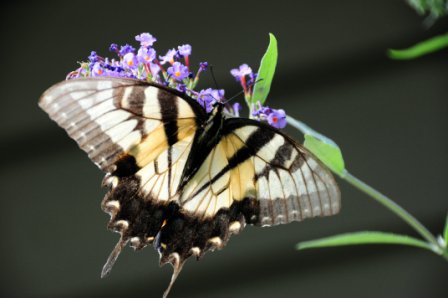
If you want to be inspired on a daily basis, marry a photographer, or at least hang out with one. You’ll get lots of practice truly observing what’s in front of you (and behind you and all around you). Because that’s what photographers do. And hanging out with a photographer provides plenty of time for contemplation (while they are sliding down into a bog to shoot a lovely little green snake and you are sitting on a footbridge, or they are setting up a tripod to shoot Joe Pye Weed and then waiting, waiting, waiting for a lull in the breeze so the photo will be in focus, or they are standing by Lake Placid at Greenville’s beautiful Paris Mountain State Park while you count the ducks). I hope you enjoy Ron DeKett’s photo of a yellow swallowtail and my poem, born of contemplating time, “Dance of the Swallowtails.” Please register on our site if you haven’t already and comment—when do you find contemplation time? Happy writing!

dance of the swallowtails

yellow swallowtail by Ron DeKett

for Ron

August 26, 2012

 You stand on Lake Placid’s shore
viewfinder framing
clear water revealing
fish just hanging out,
four ducks sailing into what was nothing like
a South Carolina August afternoon
because the sun kisses gentle
while breeze lays ripples on wet
like your fingers ruffling my hair at night
when we’re falling asleep;
viewfinder framing
swallowtails—yellow wings flirting with currents,
they dance
circle
bob
tack
do-si-do
to a sound I am sure
means
peace.
…Nan Lundeen


where were they?

They’re there – in black and white.

Where?

I found my parents on the 1940 Census. Somehow that makes them a part of history in a way I seldom see them.

My mother was right there with her parents and her younger siblings in Marlboro County, South Carolina.

The Census was taken in April of that year. Grace Jackson, my mother, graduated from Winthrop College in about June of that same year. So she probably was concerned about final exams and where she would work after she graduated.

“Being able to go to college was the fulfillment of a dream,” Grace said. “Not only was I able to go to college, but I was accepted and given a full scholarship to Winthrop College, Rock Hill, South Carolina.

“I have no idea when I decided that I wanted to be a teacher, nor do I know how I thought Papa could afford to send me to college,” she said. “I never thought about the money; I just knew I was going.”

The year Grace graduated, her yearbook summed her up: “Chronic worrier … infectious laugh … proud of being a good cook … musical snore … conscientious.”

Then came the next step.

“Graduation from Winthrop was a big day for me. It would have been better if all of my family could have been there. Only Papa and Leola were in attendance. Mama, as usual, was at home ‘keeping the home fires burning,’ and the boys, Dubert, Larue, and Carroll, were with her.

I also discovered my mother in the 1930 Census and the 1920 Census, when she was a mere four years old.

However, when I looked for my father in the 1940 Census, he was not where I expected him to be. He wasn’t listed with his parents  in Columbus, Georgia. He wasn’t at college in Brevard, North Carolina. I didn’t know how to find him if he were already in the military.

So I took a chance. There he was – in Statesboro, Georgia, listed right along with his brother and sister-in-law, John and Doris Munro, and his sister, Carolyn Munro.

What were four young people doing there?

John and Doris opened a photographic studio and were first joined by Carolyn and them my father, who had left Brevard College.

“Tom and John did the pictures,” Doris said.

Carolyn, also a photographer, helped with those and probably was a better-trained photographer at the time than Tommy was, Doris said. In fact, Carolyn and John had worked together although not professionally.

“I sat in the front at the desk and pretended like I was a businesswoman,” Doris said.

“We lived in the back of the studio. John and I slept in the posing room (moving the bed in and out}. Carolyn slept in the entry to the darkroom. Tom slept upstairs over the dark room between the roof and the ceiling. He didn’t have to move his bed every day. Tom had to climb a ladder to where he  slept.

“On Fridays we all went to the picture show. You could get in for 15 cents. They were mostly Westerns, and that was OK with me,” Doris said.

Remembering those days, she said, “The stove was in the bathroom. I scrubbed the commode every day. One day we were having spaghetti. There wasn’t any place to drain it, so I set it on the commode to drain.

“John came in and said, ‘Sweetheart, I didn’t know that you’d do that.’

“I said, ‘Well, it’s clean.”

What can you do when you have no kitchen?

I also found Daddy in the 1930 Census, but he was not counted in 1920 although he was born in February of that year.

Sometimes it’s hard to realize that family members are a part of history just as we are. History is not just the wars and generals, the politics and presidents. It also includes the farm wives fixing meals, the young people starting out, the families being created.

History, when all is said and done, is the story of people.

the nature of writing

Where does your Muse like to hang out? Mine relishes nature. My husband Ron and I hiked around Lake Placid at Paris Mountain State Park, Greenville, SC, yesterday. It was one of those rare late summer days when the light already has dipped its angle and a nip in the air whets the taste buds for fall. A waterfall glimpsed through leaves charmed my Muse. This morning, she surprised me with a love poem. I first thought the poem was going to be about falling water and taking care of our beloved Earth—something like, “We are all falling water.” But when a person fills your heart to the brim, you just gotta write a love poem! I love you, Ron. Here it is with the image that beckoned my Muse: “the wheel turns.” Please comment below to share where you most often find your Muse. Happy writing!

the first mother

Eve huddled in the scrawny shade of an olive tree.

She knew she shouldn’t be there. She had plenty of work to do, a meal to prepare and a house to clean.

 But there she sat.

 “What can I do?” she thought. “I can’t mourn Able because I’m scared of what will happen to Cain. I can’t help Cain because I’m too busy missing Able.”

 With tears trickling down her cheeks, she thought – just as the mothers who came after her would think.

 “I know this is my fault. What did I do wrong? How could I have failed Cain so much?”

 Looking up at the searing sun, she thought back over the short lives of her two sons.

 Cain, the eldest, was just 19 and a shepherd. She would have characterized him as a gentle man who could sooth the most frightened lamb. And now he was lost and frightened.

 Able. Her younger son has been a brawny youngster of 16, one who spent long hours tending the fields and nurturing his plants. When harvest was ready, he brought the first and the best of all his crops to her. Now she would never see him again except in her dreams.

 “His blood calls out to me!” she thought. “But I can’t forget Cain, who also needs redemption and help.”

 Thinking back to the Garden before she and Adam sinned and were forced out into the world full of work, pain and sorrow, she knew things could have been different. But who made it different?

 “The serpent tempted me with the fruit of the one tree God told us not to eat. But it was just one little fruit. Who knew that the knowledge of good and evil could be so devastating? So maybe it’s the serpent’s fault,” she thought.

 After mediating a bit, she shook her head slowly.

 “No, I was the one who decided to eat. Yes, the serpent enticed me. But I had a choice and I chose. As soon as I realized the sin – and how great it was – I sought cover. I found Adam and invited him to share the fruit of the tree. I thought if he refused, maybe God would forgive me because my husband was such a good man. And if he ate, at least I wouldn’t be alone in my sin.”

 “No, I can’t do that to Adam. Yes, he had the same choice that I did. But his wrong choice didn’t make my wrong choice any better,” Eve thought.

 Eve looked up again. She’d been here a long time and the sun was now low in the sky.

 “Maybe, just maybe,” she thought, “it’s God’s fault. After all, he was the one who gave us the choice. He knew what I was going to do before I did it. How is that real choice?”

 Pondering ever more deeply, the woman realized she couldn’t blame God. She would not be human if she didn’t have that choice. God may have had foreknowledge, but he didn’t force the choice.”

 There it was – all her fault. She sat with the tears trickling through the fingers.

 “Mama,” she heard. “Mama, where are you?”

 She looked up. Flying down the path was Tamara, her youngest child. The beautiful 5-year-old sang as she ran.

 “Mama, I couldn’t find you. Where did you go? It’s scary when you’re not around,” Tamara said as she sank down in the hard dirt beside her mother.

 Eve knew then that God had given her an answer for her pain.

 Yes, she had sinned. Yes, both her sons had paid for that sin.

 But she had another chance. She had Tamara, who she could teach to be thoughtful of others and God, to thank God for all her blessings and to think before she acted.

 Eve jumped up and pulled Tamara up by the hand.

 “Come along, child. We have much to do,” she said. “We have to prepare flowers for your brother Able’s grave so he’ll know we are remembering him. We must fix a lunch for your brother Cain so he can leave and find shelter elsewhere. But he’ll know we are remembering him.

 “And even more, we must laugh and sing and find your father. He is sad and we must cheer him up,” Eve said. “You are my sunshine. You must help me make the desert a home again.

 And they did.

my mother’s hands

My mother’s hands show love. I see her hands and know who it is – even without looking up at her face.

Those hands are worn. They are lined with large blue veins. They’re wrinkled with the passage of time.

Her nails are short and ridged. A few brown age spots have shown up. (I consider them decoration that doesn’t have to be added.)

Her hands have soothed children. They picked my brother Chip up when he held his arms up to be carried. They held my hand as we walked down the street, me skipping to keep up. They’ve also spanked children.

They’ve stirred food and washed dishes. They may hold dishes more gingerly now, but they still hold them. They’ve washed and iron clothes. They’ve probably been wrung together as she worried about her children or others in the family.

They’ve done more. They’ve typed letters and term papers and research papers. Those hands have learned to use a computer. They’ve graded students’ papers.

And they’ve trembled as my mother sat by a casket or a hospital bed. They’ve also been active in prayers – either the gentle kind of folded-hands prayer or the active kind of taking food to a friend.

Now they are less busy. She worries that they are too idle. But she still uses her hands for others. The methods have changed; the love has not.

My mother’s hands are lived-in hands.

– Jenny Munro

my place

I sit in a glen, surrounded and enfolded by my mountains.

The peaks, wreathed in clouds, support me with their bulk and strength.

Their green forested shoulders remind me of the peace and tranquility

Of the mountains where I grew up.

The mysterious blue haze that covers them brings dreams to my heart.//

The massive mountain ranges – and the smaller, gentler foothills – of the world

Seem as if they will endure forever.

But they erode into a valley.

Their strength and bulk can not resist the ravages of wind and rain,

Rivers and ice, fire and man.//

Still, other mountains will rise in their place,

sheltering travelers and inhabitants from the fierce wind and sun.

Therefore, I will always be secure in the embrace of my mountains.

— Jenny Munro

shooting stars

by Adamy D. Diaz

To dreams come true!

At night we look up to the sky,
Wondering what we’ll see.
And when we see a star is falling,
We quickly make a wish.

Our mind and energy,
Our thoughts and feelings,
All conspiring to bring us joy,
Conjured up the very thing
That we have just wished for.

So in a night clear and calm,
With stars as diamond glass,
If you see a shooting star
Make a wish; know in your heart,
That what you have wished for,
Soon will come to pass!


Written: February 7, 2002
A version of this poem was first Published in “The Beauty of Darkness”
by The International Library of Poetry in 2003

handful of hoppy toad

By April Moseley

Unexpected movement.
A shift on the wind.
Curiously my vision fixes
and settles on and old friend.

How do you do?
It has been too long!
Where have you been?
Can you still sing your song?

Little brown toad,
A surprise in the dirt.
Tangible piece of childhood.
A reward for being alert.

Holding you for a moment,
Sensing your fear.
I put you down wistfully,
Knowing you will be near.

Shelved nostalgia of a carefree time.
Dust-covered volumes
Untouched for years:
A crime.

Smiling, unguarded
An inner peace that glowed.
And who would have guessed how it came about-
From a handful of hoppy toad!

building memories

We’re building memories as we go –

My mother and I.

We drive together. We talk a little

And laugh a little.

We remember days past

When I was a child and

She was young

We look forward to future trips –

Short ones and longer ones.

She’s proud that at 96 she can survive 1,500 miles in a car

A little thing like a short hospital stay

Doesn’t knock her out.

It can’t. You see –

We’re building memories.

— Jenny Munro

hello, groundhog

For my health and for my writing practice, I walk a mile at an outdoor track five days a week. I greet a triangular-shaped pecan tree at one end of the track. “Good morning, tree.” Pink and blue morning glories peek through the fence. They wend their way into a haiku. One day this week, I am startled to see brown fur on short legs scampering through the grass. The fellow ducked under a storm drain cover and peered at me. It seems he wanted to be in a poem, too. Click here to read “Groundhog Day in August.” Please register at the top, right-hand side of this page if you haven’t already. We promise not to share your email address. Happy writing!

groundhog day in august

I am not a groundhog by Nan Lundeen
Brown fur, legs a blur
scurries through tall
grass, goes to ground—
a hole beneath
a storm drain slab.
Round ears
hug his head
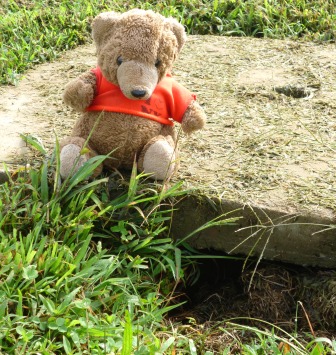
like a teddy bear’s.
He didn’t ask for company
this cool August morning
yet
he stares
cautiously wondering.
We are strange companions.
 
–Nan Lundeen

objects as memories

They’re no longer part of my mother’s house – the swans, the glass grapes, the Venetian vase.

These objects, nothing really special but always there, now live in my house along with Grace Munro Roy’s special china, a set of bamboo-design plates that came from Japan in 1952.

The swans, I think, are the oldest. I remember floating candles – home-made candles – in those swans, usually for Christmas decorations. They also housed floating blossoms, azaleas, rhododendron, a rosebud.

The red glass grapes and the red Venetian vase, once a set of two, came from Ed. I think the grapes are from Greece and the vase, of course, is from Italy. Its counterpart is with Linda, Chip’s wife, who saw it in a photo and loved it.  I also have a small bedside table that came from Ed. My mother used it in her office to store cards, but I set it beside my bed to hold my cypress knee lamp from Mr. Lake.

I haven’t used the bamboo dishes yet. I imagine their first use will come when my mother visits me.

But when I see those objects, I immediately think of her. She’s part of my home.

Of course, her presence is not new. I’ve always had part of her home in mine – the recliner, the overstuffed chair, the Richards Topical encyclopedias, the wooden lamp Daddy made and her desk, one given to her by Daddy.  I have the piano she and Daddy bought me and kept in my bedroom on Probart Street. I have the washstand from Brevard College, which looks just like the ones in Mother’s house. Over my mantle is a silk painting from Japan, one that hung over the couch in our living room.

And it’s not just my mother whose presence inhabits my home.

I have a camel teapot from Sister, my great-aunt, and a hair holder from my grandmother, Polly Munro. I have a copy of Little Gracie, Daddy’s fighter that he flew in World War II. I have the silk flowers my mother gave me for my 40th birthday and small dishes from Mary Stevenson (given by my mother) and my grandmother Munro. I have a cut-glass cookie jar that my grandmother, Maxie Jackson, gave me for my 16th birthday as well as a well-worn apron of hers.

A stuffed Tiger from my father’s ESSO station sits in my study. Daddy’s U.S. Air Force cap also rests in my study. I have a wooden vase he made in a window. A teapot from Chip and Linda graces in my kitchen window. The bellows Daddy made for our fireplace are now at mine as is the fireplace set he made as a teenager. A delicate tea cup from my great-grandmother, Belle Munro, sits on my piano. A wooden candy dish, crafted by father, sits near the television, and an ancient clay lamp from Israel came from Ed.

I’m never alone. I’m surrounded by my family and memories of them everywhere in my house.

– Jenny Munro

poetry in the park

Middle Tyger Library, Lyman, SC, by Ron DeKett
Here are the promised poems created by extraordinary ordinary people during the Poetry in the Park class I led in July at the Middle Tyger Library in Lyman, SC. Participant Marjorie Garrett wrote after the class, “I was quite impressed with what each person managed to write in such a short time.” I agree, Marjorie! After I told my husband, Ron DeKett, about the poems, he photographed some scenes in the park, which I’ve included with the poems. Click on the link after each poet’s name to read wonderful, spur-of-the-moment creations. Marjorie Garrett, “Whitewater by the Mill,” M.M. Griffin, “River Watching,” Mary Ellen Lives, “The Sign Says,” K.G. McAbee, “Dam,” and Chris Thackston, “Odd Number.” Please register with MooingAround.com at the top of the home page and comment, if you like. We promise not to share your email addresses. Thank you to all who already have registered. You are helping us build a creative community.