staff’s contributions

the typist

Tap, tap, tap.

That’s the sound I associate with my mother.

Her fingers flew over the typewriter, clicking the keys with authority.

She typed letters, short and long.

This typing professor handled manuscripts and reports and minutes, always minutes.

Concentrating, with her tongue caught between her teeth,

She set the margins just right.

While she could wield an eraser with vigor, it seldom was necessary.

She typed fast, but she also typed accurately.

Those clicking keys lulled me to sleep, made me curious, inspired me to work.

Yes – my mother could click those keys.

Tap. Tap. Tap.

– Jenny Munro

hot first lines

Contemplating great first lines of literature
Contemplating great first lines of literature.
Photo by Nan Lundeen

Hey! Grab me by the throat and throw me down. Is that an irresistible first line? Again and again we have read writing advice that the first line must grab the reader. But how? Click “what makes a grabby first line?” to gather a few tips. You make us happy when you register and comment on our site because we’re all about building a creative community. Please join us. Welcome!

psalm of pain and hope

Oh Lord, why has thou forsaken me?

Oh my God, please hear my cry of pain and rescue me.

The talons of the wild beasts tear at my body as the pain grows

And never ceases.

I have not defiled your name or your temples.

I have done good in thy sight.

But you have left me. You do not hear my cries.

Is my pain a punishment for my deeds or my thoughts?

What do I do to reach you?

As I huddle under a blanket, nursing my pain, I hear the song of birds

And see the colors of the trees. I seek cool water to quench my thirst ere I faint.

Oh Lord, I feel thy spirit enfolding me as with a warm blanket.

God, thou has not forsaken me. Thou hast given me strength to endure until I come into your kingdom.

– Jenny Munro

Note: My mother is fighting severe and continuous pain as she ages. This is dedicated to her.

autumn

Autumn by Jenny Munro

Autumn is a melancholy season

Or so the poets say.

I don’t agree.

It’s not a sad and somber time.

Fall is a gush of vivid color – red, yellow, orange and gold

Along with the differing hues of the evergreens that make their home

In my mountains – the pine, spruce, hemlock and rhododendron.

No, autumn isn’t the season of dying and death.

It’s a time when the trees and earth sink into sleep, their long winter’s nap.

That sleep strengthens the world; the seasons change and the earth awakes.

Rebirth surges with the vibrant new life, the fresh tenderness, of spring.

Autumn isn’t melancholy; it’s part of the dance of life.

– Jenny Munro

what makes a grabby first line?

by Nan Lundeen

Whether writers of poetry or prose, one challenge grins at us like the Cheshire Cat—now you see it now you don’t—the arresting first line.

What makes a line that’s memorable in the best of times and the worst of times?

Jane Austen launches Pride and Prejudice with a summary sort of line that also hints to the reader of her acerbic wit to come: “It is a truth universally acknowledged, that a single man in possession of a good fortune, must be in want of a wife.”

Sometimes the quirky suffices. For instance, “Bird-watching can be dog-eat-dog.” Who could resist reading that? The profile of a bird watcher extraordinaire by Karen Uhlenhuth was published in the Kansas City Star Magazine and compiled in an anthology of the best American sports writing of 1992.

I’m a huge fan of the late Robert B. Parker. Here’s his first line from Small Vices: “The last time I saw Rita Fiore she’d been an assistant DA with red hair, first-rate hips, and more attitude than an armadillo.”

A scene can entice you as in the first phrase of Maxine Kumin’s poem “Cross-Country Skiing.”

I love to be lured under the outstretched wings

of hemlocks heavily snowed upon, . . .

And what of a simple, rhythmic line demanding attention such as Longfellow’s, “Listen, my children, and you shall hear…”

On a dark and stormy night particularly, a spot of humor can reel a reader in, as in Amy Tan’s memoir that begins, “Soon after my first book was published, I found myself often confronted with the subject of my mortality.”

OK, I guess that qualifies toward a curiosity quotient, which I confess is my favorite lead into anything. Another example that rings my curiosity bell—George Orwell’s ” It was a bright cold day in April, and the clocks were striking thirteen.”

In the Amy Tan example, humor enters with her next sentences: “I remember being asked by a young woman what I did for a living. ‘I’m an author,’ I said with proud new authority.

“‘A contemporary author?’ she wanted to know.”

Perusing first lines, I came upon one that tops my list. Holden Caulfield begins straight off with, “If you really want to hear about it, the first thing you’ll probably want to know is where I was born, and what my lousy childhood was like, and how my parents were occupied and all before they had me, and all that David Copperfield kind of crap, but I don’t feel like going into it, if you want to know the truth.”

It’s the voice. And that may be the bottom line for me in exploring what makes a great first line. Whether it’s exposition or first-person or whatever, it’s voice that hooks me. I realize that here’s a writer I’d like to sit with awhile.

What’s your favorite first line?

The author is grateful to the SCWW Quill that first published this column.

memorable rejections

After five years of continual rejections, Agatha Christie lands a publishing deal. Her sales now number $2 billion. Only Shakespeare has sold more.

J.K. Rowling’s literary agent receives 12 publishing rejections before the eight-year-old daughter of a Bloomsbury editor demands to read the rest of Harry Potter and the Philosopher’s Stone. The editor agrees to publish it but advises the writer to get a day job.

“Too different from other juveniles on the market to warrant its selling”—rejection sent to Dr. Seuss.

“Anthologies don’t sell was the gist of 140 rejections sent to authors of Chicken Soup for the Soul, which sold 125 million copies.

“I recommend that it be buried under a stone for a thousand years,” was advice given to Vladimir Nabokov whose Lolita has sold 50 million copies.

“The girl doesn’t, it seems to me, have a special perception or feeling which would lift that book above the ‘curiosity’ level,” reads a rejection of The Diary of Anne Frank.

All of these stories and more are found at literaryrejections.com. The site is a fun read.

I like author May Sarton’s advice to writers: “Hold on, trust your talent, and work hard.”

Here’s another quote, this one from 64-year-old Diana Nyad who conquered the 110-mile swim from Cuba to Florida on her fifth attempt: “We should never, ever give up.”

And a Nyad quote for those of us still writing after “all these years,” –”You never are too old to chase your dreams.”

Nyad said that swimming “looks like a solitary sport, but it’s a team.”

You could say the same about writing. Writing buddies are invaluable, especially when the rejections roll in. Believe in yourselves, writing buddies. We believe in you.

How do you handle rejections? Please register on the site so that you can comment below. If you have trouble registering, please contact us. Thanks and happy writing!


time

It curves; it expands; it shrinks. Einstein said it is relative.

What does that mean?

As I looked at time as a little girl, I thought it stretched. Christmas took “forever” to arrive. And Christmas Eve seemed to last twice as long as it should before Santa arrived.

I reached school. Now time seemed pretty elastic. A school day sometimes seemed to be 24 hours long. But summer vacation just galloped past, not giving me time to enjoy it all.

Then I grew up. Exams could last forever. Meetings with bosses had minutes that crawled. Holidays flew past.

But I dreamed then. The speed of light was constant and nothing could go any faster. But I thought, “What would it be like if I traveled at nearly the speed of light.” I could get to the sun in what – maybe eight minutes. Or I go could back millions of light years to the ‘Big Bang’ when the universe was created.

Those were mind tricks. As I grew older, it seemed time passed faster.  It took no time from one Christmas or birthday to another.  Deadlines – a necessity in journalism – seemed to roll around faster as the years went by.

But I think, “How did I reach my 60s. Surely that many years has not passed?” And I look at my mother. She’s seen the arrival of cars, airplanes, rockets, the space shuttle. She was around for men arriving on the moon and for the explosion of the computer and the Internet.

Does her time speed by faster than mine or faster than my nieces or faster than her great-grandchildren’s? Einstein said, “No.”  I’m not sure I agree.  I’ve spent about 34,394,560 minutes on this earth. And I’m sure the ones in the last fourth of that time have sped by faster than the ones when I was a child.

– Jenny Munro

Clock in downtown Greenville.

mary grace

Grace Jackson at about age 3

She is just a little barefoot girl

Standing in the dirt.

But, oh, that cap and the flower she  clutches.

They show how much she’s loved.

This dark-haired child is growing on a tiny farm

Learning to work  the seasons through.

She helps her mother feed family and hands,

She sweeps the yard and slops the hogs and tries,

Not very successfully, to milk the cows.

Despite the farm life and the work

That little girl with the pretty dress and cap

And the mysterious gleam in her eyes

Grows up to love learning

And spends  her life teaching others to love it, too  –

Her own children and those of others.

– Jenny Munro

writing wild

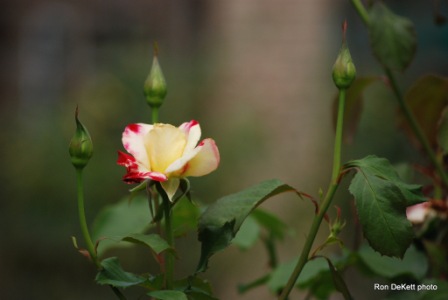
Rose by Ron DeKett
Rose by Ron DeKett

Are you a wild rose kind of writer? Or would your rose take first place at a flower show? If you’re lucky, you’re both. I tend toward the wild side of writing, at least in my dreams. And yet, I spend countless hours ensconced in my comfortable writing room chair—the one covered with the star quilt Gram made me when I was a kid in Iowa—rewriting and perfecting manuscripts. The thing is, perfection is more of a dream (read impossible) than choosing the wild rose way. What do you think? Click here to read “Call of the Wild Rose” and comment, if you so choose. I’d love to read your thoughts.

call of the wild rose

by Nan Lundeen

Rose by Ron DeKett
Rose by Ron DeKett

Inspiration or perspiration? Perfection or wild and free?

Thomas Edison’s quote that genius is 1 percent inspiration and 99 percent perspiration is good news for those of us who slog away day after day hoping to unearth gems of inspiration. I’d venture to guess that most poetry and prose writers know that if you want to be a writer you can’t wait for lightning to strike. No, you have to sit down and actually write.

We also know that once we’ve ridden the waves of creative juices and produced a manuscript, even more perspiration is required to edit, rewrite, and polish. But how much to edit, rewrite, and polish? When is it done? I’ve heard writers say when their books were published, they felt relieved because they could stop rewriting.

The other day, my husband I and went to a flower show. There we saw the most perfect white rose in the entire universe! No, really! It was a Mozart symphony all by itself, every petal harmonious with the others. Homogenous perfection, it stood in a glass vase bedecked by a blue ribbon.

Later that day as I remembered the perfect white rose, a wild rose memory washed over me, a childhood memory of pink wild roses tumbling down the shoulders of Iowa gravel roads, perfect in their disarray. A few details, a metaphor, and a simile gave me a poem. Then the pruning began. But not a whole lot. As much as the perfect rose stirs my heart, the wild roses stir my soul. I can breathe near them; the perfect rose makes me nearly hold my breath.

How much do you strive for perfection as you write? As you edit, rewrite, and polish?

At a writing workshop I heard this advice: there’s a time to expand your work and a time to tighten. Sort of like a bellows. Can you visualize them—those contraptions with handles that breathe air onto a fire? Sometimes writing may need a breath of air. Even during editing, rewriting, and polishing, it isn’t always good to tighten, tighten, tighten. A manuscript might need more elucidation, more flights of fancy.

Robert Frost describes beautifully his Faraway Meadow’s anticipated return to wildness after it has been mowed for the last time ever in his poem “The Last Mowing.” He opens the poem by telling us “the talk at the farmhouse” is that “the meadow is finished with men.” He continues to say, “Then now is the chance for the flowers/That can’t stand mowers and plowers.”


The meadow is done with the tame.
The place of the moment is ours
For you, O tumultuous flowers,
To go to waste and go wild in,
All shapes and colors of flowers,
I needn’t call you by name.
 

 What do you prefer—perfection or wild and free? There is a time, I think, to let our words tumble wantonly down the shoulders of roadsides.


The author is grateful to the South Carolina Writers Workshop for first publishing this column in the Quill October 2012.

on being bipolar

My So-Called Crazy Life” will capture your heart and set you to thinking about how our society treats people who suffer from mental illness. Traci Barr puts you right into the shoes of a person with a bipolar diagnosis. Her essay is real because she was diagnosed with the illness 36 years ago. She serves on the Board of Directors of the Greenville Chapter of the National Alliance on Mental Illness. (NAMI). Please “like” and “share” her work and register on our site if you would like to comment. Ms. Barr deserves to be heard.

a sip from the milk jug

What is Moo of Writing? It’s a method of beckoning the muse that works. Best of all, new scientific research confirms connections between relaxation and creativity. Topics for a handbook, Moo of Writing: How to Milk your Potential, burst into my consciousness years ago on a road trip. I created a first draft, and my sister-in-law Cynthia Morgan DeKett drew delightful cartoon cows to illustrate the concept. Now that I’ve retired from a job as a newspaper reporter, I’ve completed the manuscript and am looking for an agent and publisher. Meanwhile, writers who’ve read the manuscript and thoughtfully advised me on improvements, also have been clamoring for it in their hands. I hope you find this article on a few of its concepts helpful to your writing practice. Please register on our site if you haven’t already and comment in the space at the end of the article. Please share how you use relaxation to tap into creativity. Would you like to see the 100-page handbook in print? Thank you and happy writing! Here it is: what is moo of writing?

counting meditation

An easy way to rest your mind and prepare yourself for Moo of Writing is to meditate on your breaths. Lie down or sit with your spine straight and your feet flat on the floor. Focus on your breath. When thoughts intrude, let them drift by like fluffy clouds on a warm summer day. One, inhale, two exhale, three, inhale, four, exhale, five, inhale, six, exhale, seven, inhale, eight, exhale, nine, inhale, 10 exhale. One, inhale, two exhale, continue counting your breaths, beginning over when you reach 10. Enjoy your meditation as long as you like. When you are ready, come back to the here and now.


words of a wise woman

We bring to you today poems by JD, a retired Montessori teacher, a great-grandmother, and an elder whose wisdom I respect. This is the first time JD has shared her poems with the public. She writes of making words and of making bread and of God roaring in the morning, Ever a strong woman, JD writes of Lilith. In one Biblical account of creation, God creates men and women at the same time. Jewish legend names her Lilith who demanded equality with Adam. For those interested in Lilith, I recommend The Lilith Question. JD tells me she would love to see your comments on her work, so please register with our site if you haven’t yet, and comment. Here are links to her poems: november 26, 2012, july, after reading annie dillard, lilith.