what is Christmas?

Christmas for me has always been a time of magic.

It’s a time when peace is on the lips of all – even when it’s in the actions of just a few.

The season is a period of joy and quiet, or even exuberant, happiness as the timeless tale of the nativity is told again or viewed through the eyes of children..

Did you see that sheep lose it’s place. It happens all the time in pageants. And towels only look like headdresses at Christmastide.

It’s Christmas trees, the tannebaum of Germanic lore, and bright lights glimmering and silver bells ringing.

Christmas is the manger with a donkey and a camel as well as Santa Claus kneeling in front of it.

The holiday is also a holy day.

It’s a time of reflection (all of us should do as Mary did and ponder many things in our hearts).

It’s a time of giving, the one time of year that people try to think of others more than themselves.

It’s family, those that gather round the fire or the Bible and those in far-off places who gather with us in our memories and imaginations. It may also be crying babies and squabbling adults. But it doesn’t really matter. We’re all in it together.

Children all pray for snow, a glistening whiteness covering all the dreary darkness of the world.

What I like most about Christmas is that it’s a time of new beginnings: We have another chance to be the best we can be.

Let’s try it out this year.

a holiday anthology from hub city press

Josette Williams Davison reads from Imagine a Snowflake

Josette Williams Davison’s kids post themselves at windows reporting, “No snow yet, Mama, only leaves falling.” Bertice Teague Robinson writes of evergreens, clementines, country ham and memories of the young and old as her family gathers before the hearth of her rambling Southern home. Crystal Tennille Irby remembers the powerful and the holy present as Black church women teach their children how to honor the Christ Child. And Susan A. Sistare celebrates what she calls her “Hannumas House,” her home where people play dreidel games, light the menorah, eat latkes and Christmas cookies and enjoy her Christmas trees. These stories and more by 34 Spartanburg, South Carolina, writers are found in Hub for the Holidays: Spartanburg Writers on Christmas newly published by Hub City Press. Their sharing is a wonderful way to build community. Congratulations to the writers and this nonprofit press for a fun and meaningful anthology. Visit Hub City. org.

my pail runneth over

cowGraduate

My family will print my chapbook, Black Dirt Days: Poems as Memoir, in honor of my 70th birthday. Awesome! I empathize with Cynthia Morgan’s drawing of this “Mu Cow” who has graduated from a Moo of Writing class and whose milk pail runneth over. My daughter Jenny, her husband Jim, my son Jeff, and my husband Ron, told me the news and revealed the book cover when we were all together at my daughter’s house in Michigan this month. What a gift! To see the cover visit www.nanlundeen.com.

And more awesome news–the pending publication of my handbook, Moo of Writing: how to milk your potential, received a boost from Writing Magazine in the UK who published my article, “Find Your Moos,” in its December issue. The editor has written me a lovely blurb for the cover of my handbook which will come out early 2014.

What a Thanksgiving for me this year. I am grateful.


poems by Traci Barr

A Jersey gal taps her Southern roots and shares her take on Geechee red peas, sweet tea, barbecue and Frogmore stew, too in two poems, “Covered Dishes,” and “Verna.” She writes about Southern cooking as the mother of cuisine, but she’s not quite sure what y’all are really thinking when you bite into her genteel pimento cheese spread and say, “Bless your heart.”

powerful details

Mindfulness is a big buzz word these days. Used to be called awareness. No matter what you call it, both or either come in handy for writers. We need to pay close attention to detail. That means walking around in our lives with eyes and ears open, noses and taste buds alive. In a writing class, someone read a description of an explosion. The teacher asked, “Did it really boom? If it was in a ditch as you described, would it sound muffled?” That kind of explicit detail brings writing alive. I offer you examples I’m fond of in “the power’s in the details.” Please register on our site if you haven’t already and share details that have come to your attention lately.

honoring our mentors

Eternity by Nan Lundeen

Who is your mentor? Message me on Facebook or contact us through the “contact us” link on this site to let me know if you’d like to share thoughts about your mentor on MooingAround.

Jenny Munro honors her mother in her poem, “the typist.” I love how Jenny uses sound—the tap, tap, tap of her mother’s typewriter. Jenny draws a word portrait of her—”Concentrating, with her tongue caught between her teeth,” and shares a few things she learned from observing her role model.

My mentor, Sylvia Barclay, whom I knew in the 1970s in Muskegon, Michigan, generously shared writing wisdom. Whenever I asked how I could repay her she would say, “Pass it on.” That’s what I aim to do with my handbook, Moo of Writing. I was in Muskegon’s library on a hot July day when the sky turned dark. Solar eclipse. I discovered, Sylvia had passed away about the time of the eclipse, which her students found appropriate. A day or two later, I took a yoga class and meditated for the first time. Sylvia stood in my mind’s eye, her mouth pursed in a familiar expression under one of her offbeat hats. Oh, an opportunity to learn what was on the other side. “What’s it like there?” I asked. “Love is all you need to know for now, Nan.” I thought she meant I’d learn more about the afterlife in this lifetime. Hasn’t happened yet. What a gift she gave me. Love really is all I need to know.


hot first lines

Contemplating great first lines of literature
Contemplating great first lines of literature.
Photo by Nan Lundeen

Hey! Grab me by the throat and throw me down. Is that an irresistible first line? Again and again we have read writing advice that the first line must grab the reader. But how? Click “what makes a grabby first line?” to gather a few tips. You make us happy when you register and comment on our site because we’re all about building a creative community. Please join us. Welcome!

memorable rejections

After five years of continual rejections, Agatha Christie lands a publishing deal. Her sales now number $2 billion. Only Shakespeare has sold more.

J.K. Rowling’s literary agent receives 12 publishing rejections before the eight-year-old daughter of a Bloomsbury editor demands to read the rest of Harry Potter and the Philosopher’s Stone. The editor agrees to publish it but advises the writer to get a day job.

“Too different from other juveniles on the market to warrant its selling”—rejection sent to Dr. Seuss.

“Anthologies don’t sell was the gist of 140 rejections sent to authors of Chicken Soup for the Soul, which sold 125 million copies.

“I recommend that it be buried under a stone for a thousand years,” was advice given to Vladimir Nabokov whose Lolita has sold 50 million copies.

“The girl doesn’t, it seems to me, have a special perception or feeling which would lift that book above the ‘curiosity’ level,” reads a rejection of The Diary of Anne Frank.

All of these stories and more are found at literaryrejections.com. The site is a fun read.

I like author May Sarton’s advice to writers: “Hold on, trust your talent, and work hard.”

Here’s another quote, this one from 64-year-old Diana Nyad who conquered the 110-mile swim from Cuba to Florida on her fifth attempt: “We should never, ever give up.”

And a Nyad quote for those of us still writing after “all these years,” –”You never are too old to chase your dreams.”

Nyad said that swimming “looks like a solitary sport, but it’s a team.”

You could say the same about writing. Writing buddies are invaluable, especially when the rejections roll in. Believe in yourselves, writing buddies. We believe in you.

How do you handle rejections? Please register on the site so that you can comment below. If you have trouble registering, please contact us. Thanks and happy writing!


writing wild

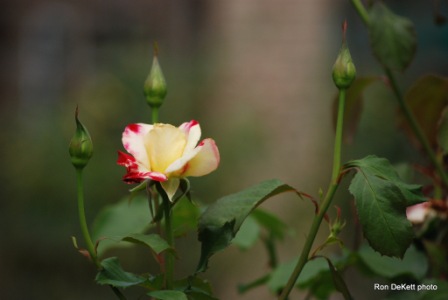
Rose by Ron DeKett
Rose by Ron DeKett

Are you a wild rose kind of writer? Or would your rose take first place at a flower show? If you’re lucky, you’re both. I tend toward the wild side of writing, at least in my dreams. And yet, I spend countless hours ensconced in my comfortable writing room chair—the one covered with the star quilt Gram made me when I was a kid in Iowa—rewriting and perfecting manuscripts. The thing is, perfection is more of a dream (read impossible) than choosing the wild rose way. What do you think? Click here to read “Call of the Wild Rose” and comment, if you so choose. I’d love to read your thoughts.

on being bipolar

My So-Called Crazy Life” will capture your heart and set you to thinking about how our society treats people who suffer from mental illness. Traci Barr puts you right into the shoes of a person with a bipolar diagnosis. Her essay is real because she was diagnosed with the illness 36 years ago. She serves on the Board of Directors of the Greenville Chapter of the National Alliance on Mental Illness. (NAMI). Please “like” and “share” her work and register on our site if you would like to comment. Ms. Barr deserves to be heard.

writing credible dialogue – enjoy m.e. corey brown’s guest blog

I hear voices in my head.

Really, all the time. They have very distinct accents and vocabulary, and each has a different tone, melodic or husky, a unique style, slow and confident or abrupt and nervous. Each voice changes very slightly depending upon which of the other voices it is speaking with at the time.

That’s right. The voices in my head speak to each other, not to me. That would just be silly.

It is a very rare voice which does not change depending on its audience. Most do. When speaking to a lover, a rival, a mentor or a sibling, don’t our tones and vocabulary differ a bit? Don’t we tense our consonants around some people, while relaxing our vowels around others? We even express ourselves differently based upon the age of our audience.

Writing dialogue is an exercise in sociology, maybe even a psychological experiment. We as authors must know not only how our character feels about a topic, but also how he feels about the person he is conversing with about the topic. How much can any character truly reveal about her opinion in this situation? Has an opinion even really been solidified?

The voices in my head are fantastic companions, with a wide range of personalities. I exist to place them in situations which are beyond their comfort zones, and among people who test their beliefs and understanding of their worlds, so that they come to know their own true selves to the extent that it is ever possible to do so. And perhaps as I am doing that, I am learning something about my own voice as well.

~Michelle

ME Corey Brown is the author of the fantasy novel Champion of the Moon Glories available on Amazon.com. www.moonglories.com


a sip from the milk jug

What is Moo of Writing? It’s a method of beckoning the muse that works. Best of all, new scientific research confirms connections between relaxation and creativity. Topics for a handbook, Moo of Writing: How to Milk your Potential, burst into my consciousness years ago on a road trip. I created a first draft, and my sister-in-law Cynthia Morgan DeKett drew delightful cartoon cows to illustrate the concept. Now that I’ve retired from a job as a newspaper reporter, I’ve completed the manuscript and am looking for an agent and publisher. Meanwhile, writers who’ve read the manuscript and thoughtfully advised me on improvements, also have been clamoring for it in their hands. I hope you find this article on a few of its concepts helpful to your writing practice. Please register on our site if you haven’t already and comment in the space at the end of the article. Please share how you use relaxation to tap into creativity. Would you like to see the 100-page handbook in print? Thank you and happy writing! Here it is: what is moo of writing?

words of a wise woman

We bring to you today poems by JD, a retired Montessori teacher, a great-grandmother, and an elder whose wisdom I respect. This is the first time JD has shared her poems with the public. She writes of making words and of making bread and of God roaring in the morning, Ever a strong woman, JD writes of Lilith. In one Biblical account of creation, God creates men and women at the same time. Jewish legend names her Lilith who demanded equality with Adam. For those interested in Lilith, I recommend The Lilith Question. JD tells me she would love to see your comments on her work, so please register with our site if you haven’t yet, and comment. Here are links to her poems: november 26, 2012, july, after reading annie dillard, lilith.

a secret to good writing

four ducks in a row by Ron DeKett

If you want to be inspired on a daily basis, marry a photographer, or at least hang out with one. You’ll get lots of practice truly observing what’s in front of you (and behind you and all around you). Because that’s what photographers do. And hanging out with a photographer provides plenty of time for contemplation (while they are sliding down into a bog to shoot a lovely little green snake and you are sitting on a footbridge, or they are setting up a tripod to shoot Joe Pye Weed and then waiting, waiting, waiting for a lull in the breeze so the photo will be in focus, or they are standing by Lake Placid at Greenville’s beautiful Paris Mountain State Park while you count the ducks). I hope you enjoy Ron DeKett’s photo of a yellow swallowtail and my poem, born of contemplating time, “Dance of the Swallowtails.” Please register on our site if you haven’t already and comment—when do you find contemplation time? Happy writing!

the nature of writing

Where does your Muse like to hang out? Mine relishes nature. My husband Ron and I hiked around Lake Placid at Paris Mountain State Park, Greenville, SC, yesterday. It was one of those rare late summer days when the light already has dipped its angle and a nip in the air whets the taste buds for fall. A waterfall glimpsed through leaves charmed my Muse. This morning, she surprised me with a love poem. I first thought the poem was going to be about falling water and taking care of our beloved Earth—something like, “We are all falling water.” But when a person fills your heart to the brim, you just gotta write a love poem! I love you, Ron. Here it is with the image that beckoned my Muse: “the wheel turns.” Please comment below to share where you most often find your Muse. Happy writing!